Home › Concrete Slab Installation
Get a level, durable base with professional concrete slab installation in Fort Smith, AR. We pour concrete floor slabs for homes, sheds, patios, and garages with proper reinforcement and thickness. From small shed slabs to full house slabs, our crew ensures stable support for your structure.
Superior Concrete Fort Smith provides professional concrete slab throughout Fort Smith, AR, Arkansas and the surrounding area. Our licensed, insured crew delivers safe, clean, on-time work with a free estimate before anything begins. Call 479 346 0698 or request your free quote.
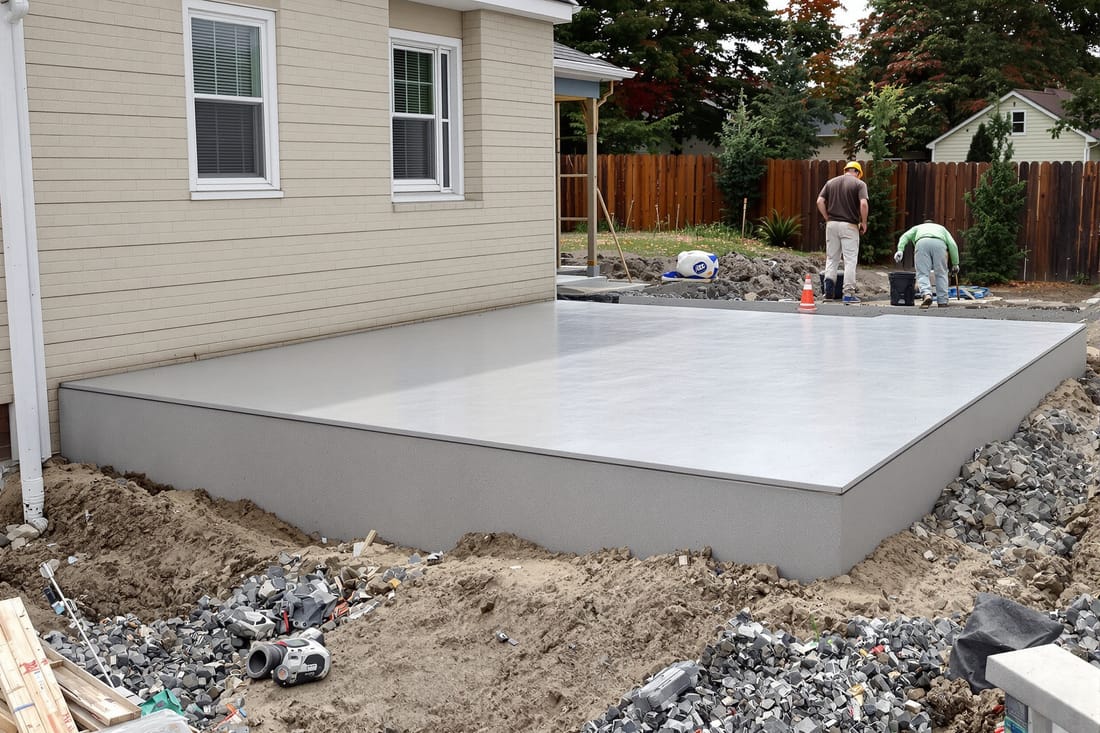
Concrete Slabs Built for Fort Smith Conditions
Concrete slabs look simple from the surface, but getting one that stays flat and crack resistant in Fort Smith takes planning, good soil prep, and the right concrete mix. Superior Concrete Fort Smith focuses on the details that actually decide whether your slab will hold up for ten years or start shifting in the first two.
When we talk about a concrete slab, we are usually talking about a flat structural surface that might support a shed, shop, garage, room addition, patio, driveway extension, or equipment pad. The size, thickness, and reinforcement we choose for you depends on what will sit on top. A 4 inch patio slab for lawn furniture is not engineered like a 6 inch shop floor where a 3/4 ton truck will park.
Our crews work across Fort Smith, Van Buren, Barling, and nearby towns with the same approach. We start by looking at how your yard drains during heavy Arkansas rains, what kind of soil you have, and how close we are to property lines and easements. That upfront check lets us design a slab that is the right thickness, has the right reinforcement, and sits at the right elevation so water moves away from your home instead of into it.
How We Install a Concrete Slab, Step by Step
Concrete slab installation from Superior Concrete Fort Smith follows a clear process so you know exactly what is happening on your property.
Site evaluation and layout: We visit your property, measure the area, look for utility lines, and check grade. In Fort Smith most neighborhoods are under the Arkansas One Call system, so we schedule utility locates before digging. We then mark the slab corners with stakes and string lines so you can see the footprint.
Excavation and base prep: We strip sod and organic material, then excavate to the depth needed for the slab and base rock. For typical residential work we install 3 to 4 inches of compacted crushed stone or gravel under a 4 to 6 inch concrete slab. On soft or expansive clay soils that are common in the River Valley, we may over excavate and add more base material to reduce heaving and settling.
Forming: We use straight 2x4 or 2x6 lumber or metal forms to create a clean edge at the exact elevation we want. Forms are staked and braced so they do not move when the concrete truck backs up or when we screed the concrete. At this stage we also plan slopes. For patios and exterior slabs we typically build in about 1/8 inch fall per foot away from structures so water drains correctly.
Reinforcement and vapor control: Depending on the use, we install rebar, wire mesh, or both. For garage and shop floors we usually set a grid of 3/8 inch or 1/2 inch rebar on chairs at mid depth of the slab. For interior living space slabs or where moisture control matters, we install a 6 mil or thicker vapor barrier over the base rock before placing steel.
Placing and finishing concrete: We schedule concrete delivery from local Fort Smith batch plants, using a mix design suited to the application, often 3000 to 4000 psi with air entrainment for exterior slabs that see winter freeze and thaw. Our crew spreads the concrete, screeds it to grade using straight boards or power screeds, then bull floats to smooth and bring paste to the surface. As the concrete sets, we edge the slab, cut control joints at the right spacing, and finish the surface. Finish options include light broom for traction on patios and driveways, steel trowel for interior floors, or textured finishes that accept coatings later.
Curing and clean up: We keep the slab from drying out too fast, which is a major cause of early cracking. We may apply a curing compound or ask you to lightly water the slab for a few days, depending on weather. Finally we strip forms, backfill along the edges, and leave the site clean and ready for use once the concrete has reached enough strength.
Options for Thickness, Reinforcement, and Finishes
Not every concrete slab in Fort Smith should be built the same way. Superior Concrete Fort Smith lays out your options in plain language so you can decide what makes sense for how you plan to use the space.
Slab thickness and strength: For light duty patios and walkways we usually recommend a 4 inch slab with a 3000 psi mix. For driveways, RV pads, or shop floors that will see heavier loads we may move to 5 or 6 inches thick and 3500 to 4000 psi concrete. If you plan to park something even heavier, like a loaded equipment trailer, we can increase thickness and adjust reinforcement so the slab does not flex and crack.
Reinforcement choices: Basic slabs may use wire mesh, but many Fort Smith homeowners choose rebar grids because they handle soil movement better. For example, a 20x20 garage slab might get #3 rebar at 18 inches on center each way, while a larger 30x40 shop might use #4 rebar at 16 inches on center. On some slabs we also add fiber reinforcement in the concrete mix to reduce plastic shrinkage cracks.
Finish and surface options: For exterior slabs that get wet, such as porches and driveways, we recommend a broom finish so you do not end up with a slick surface in the rain. Interior or future-finished spaces often get a machine trowel finish that is flatter and ready for epoxy, stain, or flooring. We can saw decorative patterns, create thickened edges for brick or stone borders, or leave smooth edges where future walls or metal building frames will attach.
Add-ons that matter in daily use: Clients often ask about thickened edges or turn downs. These are deeper perimeter sections under the slab that provide extra strength at the edge or serve as shallow foundations under load bearing walls or metal buildings. Another option is embedding anchor bolts or plates for steel buildings. We set these during the pour based on the building supplier’s plans so your structure lines up exactly with the slab.
Costs, Permits, and Local Fort Smith Considerations
The cost of a concrete slab in Fort Smith is mostly driven by size, thickness, reinforcement, and site conditions, not just a simple price per square foot. Superior Concrete Fort Smith walks you through these factors before you commit.
Material and size: More square footage means more concrete, base rock, and forming materials. Thicker slabs use more concrete per square foot, which directly affects the price. A 4 inch patio might be on the lower end, while a 6 inch shop floor with thicker base rock and rebar will be higher.
Access and site conditions: If the concrete truck can back close to the forms, the job is more efficient. Tight backyards that require pumping concrete or wheelbarrowing long distances add labor and sometimes equipment costs. Soil that needs undercutting or extra rock also increases cost, but it usually saves you money over time by avoiding slab repairs.
Permits and inspections: Within Fort Smith city limits, some concrete slabs require permits, particularly if they are part of a new structure, room addition, or attached garage. Free standing patios or small shed slabs are sometimes exempt, but rules can change. We help you understand when a building permit, footing inspection, or engineer’s design is needed. For example, if the slab will support habitable space, local code may require a specific vapor barrier and thickened footing design for the perimeter.
HOA and property line issues: Many neighborhoods in and around Fort Smith have HOA rules about how close you can build to the fence line and how high the finished slab can sit. Our layout process considers setbacks so you do not end up with an expensive slab that has to be modified. We also aim to keep finished elevations in line with existing patios and door thresholds so you do not trip or end up directing water into your foundation.
Weather timing: In Arkansas the combination of summer heat and sudden storms can affect scheduling. We avoid pouring slabs right before a storm front or on days that are too hot with no shade and no wind. When we do pour in warmer weather, we may adjust the mix, use set retarders, or plan extra finishing labor to keep the slab from setting up too fast and creating surface problems.
Preventing Problems and What to Expect After the Pour
Done correctly, a concrete slab should quietly do its job for decades. The issues most Fort Smith property owners see, like random cracking, standing water, or spalling, usually start with shortcuts during installation. Superior Concrete Fort Smith is very open about where we draw the line so you know what to expect.
Cracking control: All concrete cracks to some degree as it shrinks and the ground moves. The goal is to control where that cracking happens. We do this by installing control joints at the right spacing and depth, typically every 8 to 12 feet on a 4 inch slab. We also pay attention to joint layout at re-entrant corners near steps or inside corners of buildings, where stress likes to concentrate.
Drainage and settlement: Before we pour, we address soft spots in the subgrade and bring in compacted base rock to support the slab. If we see evidence of poor drainage from gutters or uphill yards, we may suggest small grading changes or drains so water does not wash out the base under your slab over time. A little extra prep can prevent corner settling and cracking that shows up a year after the pour.
Surface durability: For exterior slabs that will see deicing salts from vehicles or heavy equipment, we pay special attention to air entrainment and proper curing so the surface does not flake in winter. We avoid overworking the surface with water or adding dry cement on top, two habits that create weak surfaces that dust and flake.
Your role after installation: You will get clear instructions on when you can walk and drive on your new slab. Typically, light foot traffic is fine after about 24 hours, lawn furniture and light loads after several days, and vehicles after a week or more, depending on weather and mix strength. We will let you know how long to keep heavy trailers and equipment off the slab and how to maintain joints or sealers if you choose to use them.
If you want a concrete slab that is tailored to your project and your property in Fort Smith, Superior Concrete Fort Smith is ready to look at your site, talk through the options, and give you a detailed plan instead of a guess on price and performance.